
What’s all the fuss about magnesium?
Magnesium is a real over-achiever in our bodies; playing a role in energy metabolism, mood regulation, digestion, blood sugar management, muscle recovery, hormone balance… I could go on. It’s pretty important and many of us don’t get enough in our diets. Check below to see how much you need, what foods can help you meet your needs, and whether or not you should consider a supplement
I’m sure you’ve noticed lately that whatever ailment you google the internet is likely to suggest magnesium as the solution…
🥱 Can’t sleep? Magnesium.
🤢 Constipated? Magnesium.
😫 Muscle cramps after a workout? Magnesium.
😵💫 Feeling stressed, wired, or just off? Yep… magnesium.
And while I’m not one to jump on an internet nutrition trend, I have to say on this front the internet is kind of onto something.
Why Magnesium Matters
Often we think of muscle cramps or sleep when it comes to what magnesium does in our body, and it absolutely helps with those things. But, that’s not everything this over-achiever mineral does. Magnesium is involved in over 300 biochemical reactions in the body (which is a LOT).
Magnesium helps your body:
⚡️ Create steady energy throughout the day
🩸 Regulate blood sugar and insulin sensitivity
💪 Contract and relax muscles
🛜 Send messages along nerves smoothly
🦴 Build strong bones
😴 Relax into restful sleep
🧘♀️ Regulate your nervous system for better stress resilience
💩 Break down foods and move them through your GI tract
And here’s the kicker: up to 50% of people do not meet their daily magnesium needs (1). That includes many women with PMOS (formerly known as PCOS), athletes, and anyone dealing with lots of stress. So… basically all of us!
How much magnesium do I really need?
The Dietary Reference Intakes (DRIs) set by the U.S. health institutions recommend adult men and women get between 300-400mg of magnesium per day. I think this is a good start, but often find my patients do better with sleep, moods, GI regularity, and blood sugar regulation with significantly higher intake of magnesium, sometimes even double the DRI.
How do I get more magenesium?
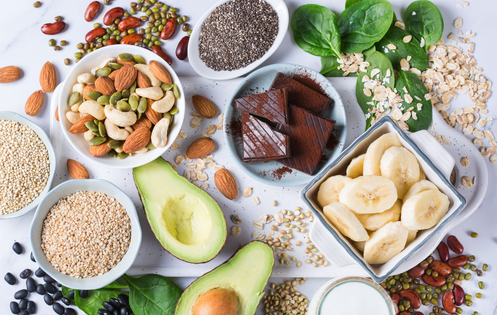
Magnesium is found naturally in plant foods, especially those with fiber, chlorophyll, or healthy fats. Think 🥜 nuts, 🌰 seeds, 🥬 leafy greens, 🫘 legumes, and 🌾 whole grains.
Ideally we focus on increasing our intake of magnesium-rich foods before looking at supplements because these foods also deliver antioxidants, fiber, and gut-friendly nutrients that work together with magnesium to support hormone balance and metabolic health.
How to get magnesium from foods
🥬 Leafy Greens
½ cup cooked Spinach ~79 mg
½ cup cooked Swiss chard ~81 mg
½ cup cooked Kale ~168 mg
These greens get their deep color from chlorophyll, and magnesium sits right at the center of that molecule. In other words, dark greens = magnesium gold.
🥜 Nuts and Seeds
1 oz roasted Almonds ~80 mg
1 oz roasted Pumpkin seeds ~156 mg
1 oz roasted Cashews ~74 mg
Pumpkin seeds are one of the highest magnesium sources per ounce. Sprinkle them on yogurt, salads, or oatmeal for an easy boost!
🫘 Legumes
½ cup cooked Black beans ~70 mg magnesium
½ cup cooked Lentils ~36 mg magnesium
½ 3cup Chickpeas ~21 mg magnesium
½ cup cooked Edamame ~50 mg magnesium
These are blood-sugar-friendly, satisfying, and wallet-friendly protein sources. A triple threat!
🌾 Whole Grains
½ cup cooked Old Fashioned Oats ~40 mg magnesium
½ cup cooked Quinoa ~118 mg
½ cup cooked Brown rice ~44 mg
½ cup cooked Barley ~22 mg
Whole grains contain magnesium in their bran layer, which is stripped away in refined grains. Another reason to choose whole grains when you can!
🐟 Fatty Fish
3oz cooked Salmon ~29 mg
3oz cooked Mackerel ~76 mg
3oz cooked Halibut ~23 mg
A nutrient-dense option that supports decreasing inflammation, supporting heart health, and balancing hormones.
✨Bonus Sources You’ll Love
1oz Dark chocolate >70% (yes, really!) ~64 mg
½ an Avocado ~20 mg
1 Banana ~30 mg
5oz Yogurt ~17 mg
Tofu ~40 mg
These are easy to add to snacks, smoothies, or meals without overthinking it.
Looking for inspiration? Check out my High Magnesium Foods Pinterest board where I’ve pulled together dozens of delicious magnesium-rich recipes like:
Dark chocolate quinoa crisps
Coconut energy bites
Matcha overnight oats with chia seeds
...and many more magnesium-rich favorites!
Do I Need a Supplement?
Maybe. Some people may benefit from magnesium supplements, especially those with low intake, GI disorders, or certain medications, but food should always be the foundation. Your dietitian or another healthcare provider can help determine whether a supplement is appropriate for you. Generally speaking, magnesium glycinate is a better absorbed form of magnesium than what many grocery and drug store brands contain (magnesium oxide), and I always recommend looking for that form. You can find some of my favorite magnesium supplements here.
The Bottom Line 🌿
Getting enough magnesium matters, and many of us don’t. Start by adding these magnesium‑rich foods to your routine and watch how much better your body feels when it finally gets what it needs.
Boost your energy, nourish your muscles, and savor every snack. Magnesium has your back 😋
Sources:
Publication : USDA ARS. (n.d.). https://www.ars.usda.gov/research/publications/publication/?seqNo115=331867
Magnesium fact sheet for consumers. (n.d.). https://ods.od.nih.gov/pdf/factsheets/magnesium-consumer.pdf
Fooddata Central Frontpage. USDA FoodData Central. (n.d.). https://fdc.nal.usda.gov/